
Federal BOP Release Records
The Federal Bureau of Prisons locator covers federal inmates incarcerated from 1982 to the present. It is the correct starting point for a person who served a federal sentence. It is not the Lamar County jail roster, a Georgia DOC search, or a complete record of federal pretrial detention.
BOP explains that a past release date with no facility location means the person is no longer in BOP custody. The result may display “Released” or “Not in BOP custody.” That status ends only the BOP part of the search. The person may still be in another correctional system or under supervision.
Search Federal BOP Releases
Open the official BOP inmate locator. Search by BOP register number when known because it gives the strongest match. A name search can also use race, age, and sex filters. Compare every returned identifier before opening a record.
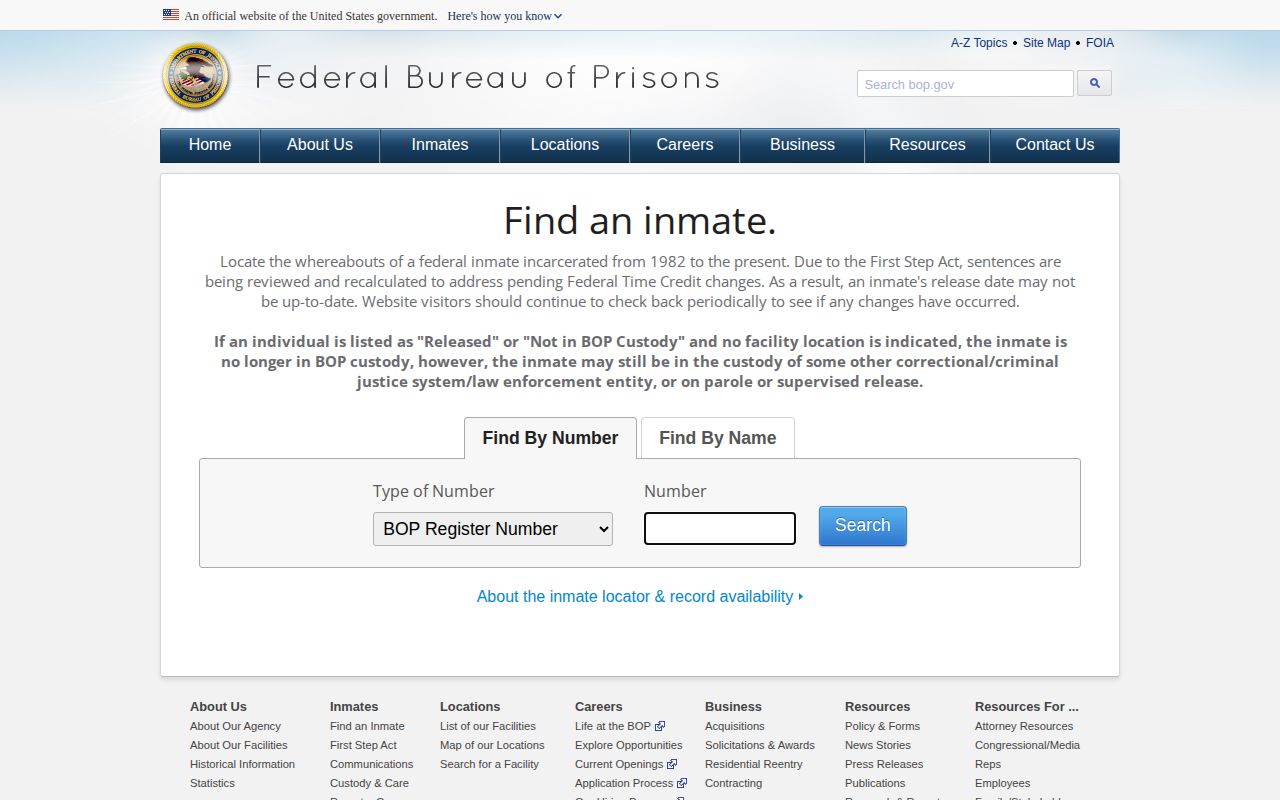
The captured federal search page shows the proper starting point for a BOP record and helps prevent a federal sentence search from being sent to Lamar County or GDC.
- Choose number or name search.
- Enter the register number or full name.
- Use available filters to narrow matches.
- Read the location and release-date fields.
- Check another system if BOP custody ended.
The locator's date is a federal record, not proof of where the person went next. For the original local event, use the Lamar County release guide. A Lamar arrest may be unrelated to a later federal sentence, or a federal detainee may have been housed locally under an agreement.
Federal Released Status Meaning
BOP's records explanation says that when the listed release date is past and no facility is shown, the person is no longer in BOP custody. The term does not guarantee unrestricted return to the community. Another warrant, state sentence, immigration matter, or supervision term can follow.
| BOP result | Careful reading |
|---|---|
| Facility listed | Record identifies a BOP placement |
| Past release date | BOP custody ended on the date shown |
| Released | Person is no longer held by BOP |
| Not in BOP custody | Search another authority when facts point elsewhere |
| No match | Check spelling, number, date coverage, and other systems |
Save the register number and result date. They help distinguish people with similar names and support a more precise records inquiry.
Federal Pretrial Custody Differences
The U.S. Marshals Service manages custody for many federal defendants before trial and sentence. USMS explains that a person arrested under federal law appears before a judge and may be released or remanded. “Remanded” means ordered into custody while the case proceeds.
USMS uses federal, state, local, and private facilities through agreements. A federal detainee can therefore be physically held in a local jail without becoming a county defendant or BOP sentenced inmate. The BOP locator may not settle that pretrial status. Check the federal court and USMS when the case has not reached a BOP sentence.
Lamar Federal Detainer Releases
A Lamar County booking can end through transfer on a federal hold or detainer. A detainer is a request from another authority to hold or transfer a person. The sheriff's release record may show that local custody ended, but it may not mean the person returned to the community.
Ask the sheriff for the inmate information sheet, release reason, and transfer notation. Then follow the named federal agency. If the record shows an immigration detainer, use ICE rather than BOP. If it shows a federal criminal warrant, use the federal court, USMS, and BOP according to the stage of the case.
Federal Supervision After Release
BOP cautions that a released person may remain on parole, supervised release, or in another custody system. Federal supervised release is a court-ordered period after imprisonment. It is not the same as Georgia parole or DCS felony probation.
The federal judgment and docket explain any supervised-release term. A federal probation office handles federal community supervision. Do not send that question to DCS Barnesville unless a separate Georgia case also created state supervision. One person can have records in more than one system.
Federal BOP Record Limits
BOP locator coverage begins with inmates incarcerated from 1982 to the present. Older federal records require archival research. Name spelling, aliases, incomplete identifiers, and custody outside BOP can also cause a missing result. No match does not prove that no federal case exists.
Use the federal court docket for the judgment, sentence, and later orders. Use BOP for sentenced custody and its release date. Use USMS for relevant pretrial custody questions. Use the receiving agency when a transfer follows BOP release.
Federal BOP Verification Route
When public fields are not enough, make a focused request to the agency that created the record. Provide the full name, register number, date of birth, federal court, case number, and approximate custody dates. Ask for the specific release or transfer fact needed.
Keep observed facts separate from assumptions. A past BOP date proves the BOP event described by that record. It does not prove current residence, the end of all supervision, or the absence of a state or immigration hold. Check the most recent responsible authority.
BOP Versus Georgia Custody
GDC covers Georgia state sentences. Lamar County Detention Center covers local bookings and county custody. BOP covers federal sentenced prisoners. These locators cannot be substituted for each other merely because the same name appears.
Begin with the court and sentence type. A Lamar County Superior Court sentence points toward Georgia systems. A United States District Court sentence points toward BOP and federal supervision. The court caption is often the quickest way to choose the correct release search.
Federal sentence dates can reflect calculation rules that are not visible in a short locator result. The judgment states the sentence imposed, while BOP computes custody dates under federal authority. If a date appears wrong, compare the judgment, commitment record, jail credit, and BOP record rather than estimating from sentence length alone.
Release planning may involve a residential reentry center, home confinement, supervised release, or a transfer. Those terms describe different legal placements. The public locator may not explain every step. Ask BOP or the federal court for the exact record tied to the date and status being verified. Note the search date and keep the register number with the result. If a later search changes, those details help the records office identify the event and explain whether a transfer, correction, or update occurred.