
Lamar County Parole Versus Probation
Parole and probation both allow a person to live outside a jail or prison while following set terms, but they begin in different ways. The State Board of Pardons and Paroles decides state parole. The Georgia Department of Community Supervision, or DCS, handles field supervision for state parole and felony probation. A Lamar County court imposes probation as part of a sentence. Local misdemeanor cases may be routed to a different reporting office, so a missing name in a state parole search does not prove that all supervision has ended.
| Record type | How it begins | Lamar County verification |
|---|---|---|
| Parole | Board-approved release from a state prison sentence | Parolee database, Board records, and DCS Barnesville |
| Felony probation | Superior Court sentence or placement | Court disposition and DCS Barnesville |
| Misdemeanor probation | Local court sentence | Court record and the named local probation office |
| Accountability court | Alternative sentencing with court oversight | Towaliga court records and program contacts |
Custody status and supervision status are not the same. A live jail roster concerns people still held at the Lamar County Detention Center. A parole or probation record concerns someone in the community under formal terms. The original release reason and time remain in sheriff, GDC, or court records, while the supervision source shows the next stage.
- Parole
- Conditional release from a state prison term before the maximum release date.
- Probation
- A court sentence served in the community under stated rules.
- Discharge
- The formal end of a sentence or supervision term.
- Absconder
- A supervised person alleged to have stopped reporting or left supervision without approval.
Check Lamar County Post-Release Supervision
Start with the custody path, not a broad name search. Someone released from a county booking on bond may have no parole record. A person transferred from Lamar County to GDC may later appear in state parole records. Someone sentenced to probation by a local court may be supervised through DCS or a named misdemeanor provider. Matching the court and sentence type prevents false conclusions.
- Check the court disposition for the sentence, probation type, and any named supervising agency.
- For state parole, search the Georgia parolee database and compare identifiers.
- For a person still in prison, use the TPM lookup. A tentative parole month is not proof of release.
- For parole or felony probation in Lamar County, contact the DCS Barnesville Field Office.
- For a misdemeanor case, follow the court record to the local probation provider rather than assuming DCS has the file.
- Confirm any warrant, violation, or discharge through the court or supervising agency that created the record.
The state tools answer different questions. The TPM lookup concerns possible future parole review. The parolee database is the better path once parole is active. DCS can confirm the local field-office route but does not replace the jail's release record. For the initial county release event, use the sheriff and court path described on the Lamar County released-inmates search.
Lamar County Felony Supervision Office
DCS Barnesville serves Butts, Lamar, and Monroe Counties and the Towaliga Circuit. It is the local field office for state felony probation and parole supervision. It is not a detention facility and does not publish a jail release list. Contact the office when a court or parole record points to DCS supervision after release.
Georgia Department of Community SupervisionBarnesville Field Office
700 Legacy Park Dr
Barnesville, GA 30204
Monday through Friday, 8:00 AM to 4:30 PM
The DCS felony-supervision information explains the statewide role. Bring or provide a full name, case number, parole identifier, and court details when known. Staff may limit information due to law, safety, or case status. A field-office response confirms the supervision channel, not the exact time a person walked out of a jail or prison.
The official DCS Barnesville page shows the office used for Lamar County felony supervision.
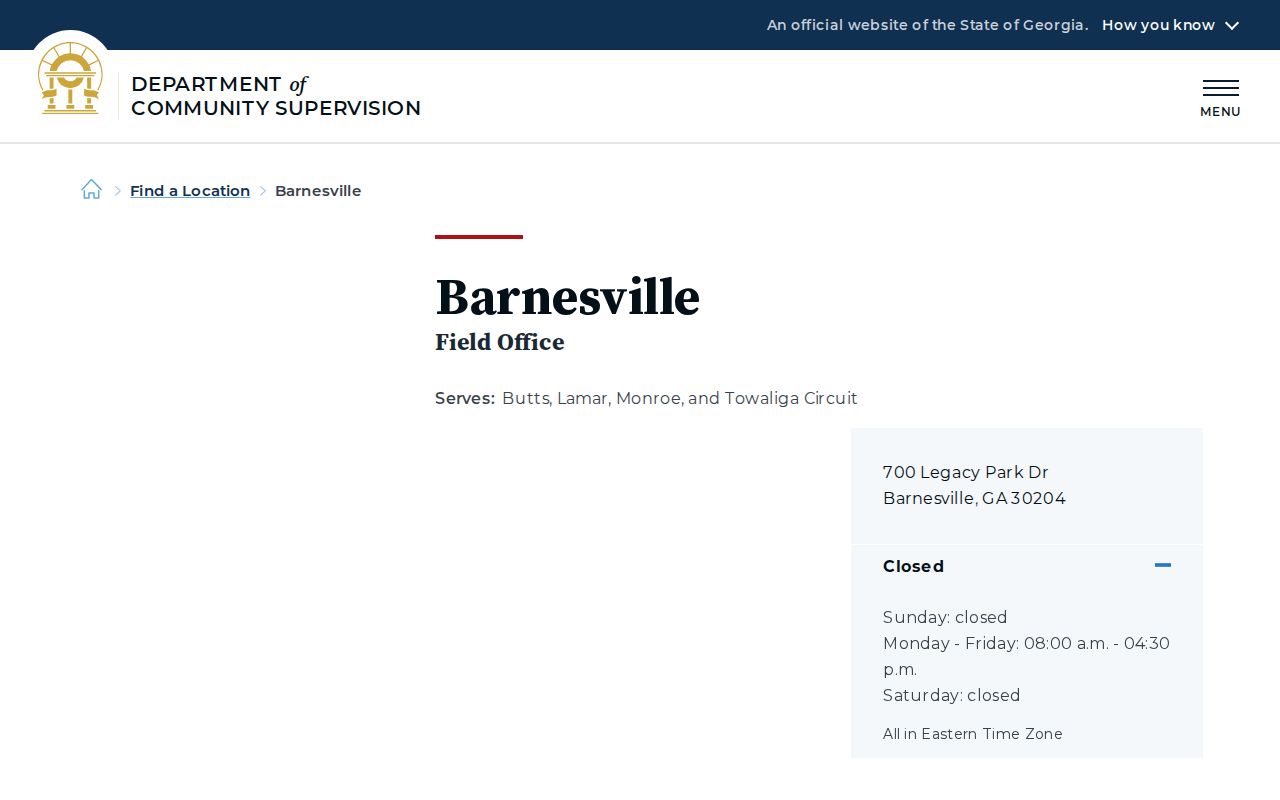
This office page anchors a supervision check to the correct local state agency.
Lamar County Supervision Violations
Conditions vary by sentence and case. Common terms may require reporting, travel approval, treatment, testing, curfews, payment, or compliance with court orders. The supervising officer and filed court order are the sound sources for a specific person's terms. Do not infer a violation merely because a public database looks stale or a person is not found.
An absconder is a person alleged to have stopped reporting or left supervision without permission. That status can lead to a warrant, but the warrant or violation must be confirmed through the supervising agency and the court. A detainer is a request from another authority to hold or transfer a person. It can change where someone goes even when the original custody term ends.
Georgia VINELink may provide custody-change alerts where an agency supplies data, but it is not a complete probation-violation registry. The parolee database, DCS, and the court record remain the key supervision sources. For an urgent safety issue, use the responsible agency rather than relying only on an automated alert.
Lamar County Supervision Discharge
Supervision ends through a formal act, not by a name simply disappearing from a web result. Parole may end at discharge or sentence expiration. Probation may end when the court term and all lawful conditions are complete, or when a court enters an order that changes the sentence. The Board, DCS, or sentencing court creates the controlling record.
Ask for the discharge certificate, court order, or agency confirmation when exact proof matters. An inactive GDC record may help establish that state custody ended, while a court docket may show completion or modification of probation. Record restriction is a separate process. It changes access to qualifying arrest history and does not by itself mean supervision ended.
Georgia parole law includes general eligibility rules in O.C.G.A. 42-9-45, but eligibility is not discharge. The Board may deny, postpone, reconsider, cancel, or withdraw a parole grant before it takes effect. Serious-offense rules and other exceptions can also control the result.
Lamar County Accountability Court Supervision
Towaliga Accountability Courts operates from Barnesville and serves Lamar County with Butts and Monroe Counties. Its alternative-sentencing programs can involve court check-ins, intensive treatment, counseling, drug testing, curfews, and supervision. A participant may therefore be out of jail while still subject to a highly structured court plan.
This channel is distinct from parole. The court, not the Parole Board, places an eligible person into the program. It is also more than a simple custody result. Verify participation and terms through the relevant court and program records, while using the sheriff record for the original jail release.
A release search that stops at “not in jail” misses this local layer. Towaliga records can explain continued appearances, testing, and case-management duties after the person has left Lamar County custody.
Lamar County Misdemeanor Probation
Lamar County has a second local reporting path. Judicial Alternatives of Georgia in Barnesville appears as a local misdemeanor and private probation office, while DCS Barnesville handles state felony community supervision. The split is vital because not every person on probation will appear in the same state system.
Judicial Alternatives of Georgia18 Zebulon Street
Barnesville, GA 30204
770-358-4370
Use the court disposition to decide which office is relevant. A misdemeanor probation order may identify Judicial Alternatives. A felony order may point to DCS. The office record helps confirm reporting, but the sentencing court controls the legal terms and any later change.
The Barnesville office listing shows the local misdemeanor route.
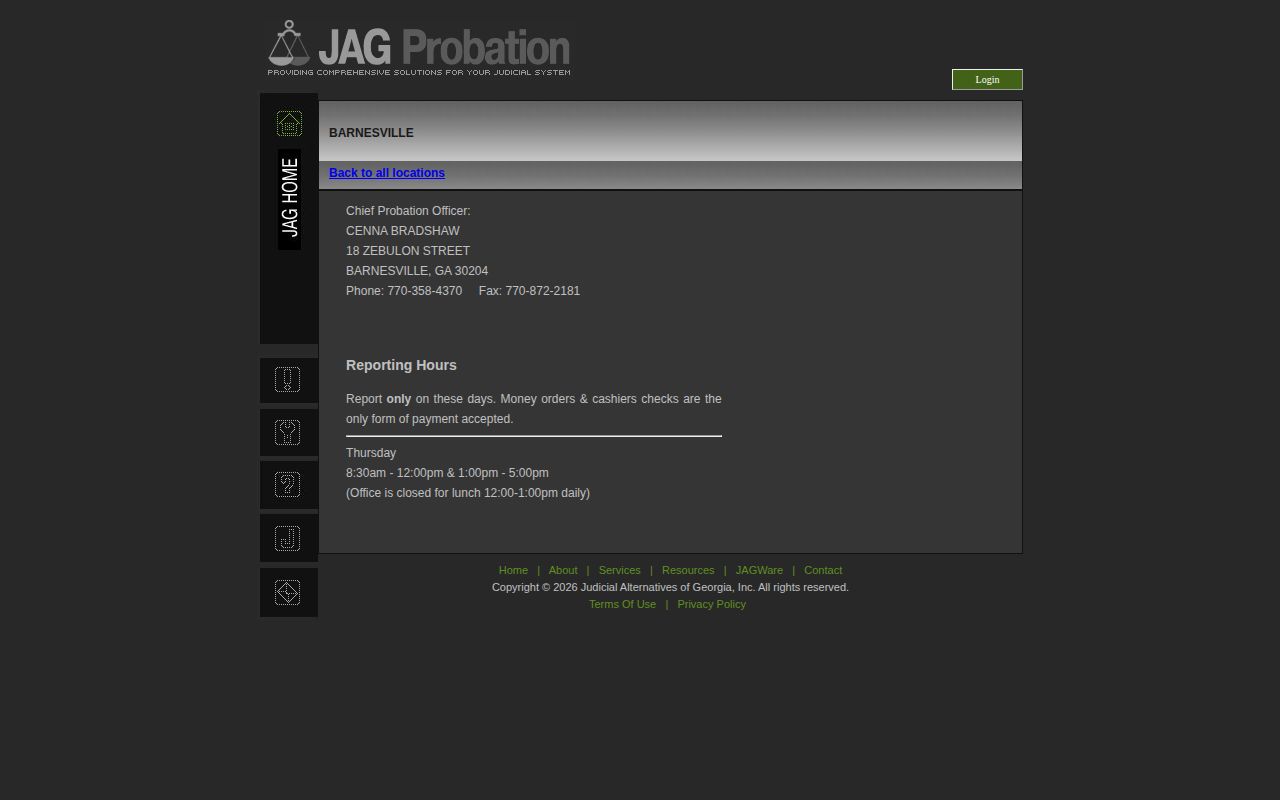
This listing helps separate local misdemeanor reporting from state felony supervision.
Lamar County Post-Release Property
Release also creates practical tasks that supervision databases do not show. The sheriff's inmate support information says commissary that arrives after release or transfer may be collected by the person or a designated family member within five days. If it is not collected in that period, it is destroyed.
The jail's communications page provides another local step. A released person may request digital copies of scanned mail by emailing Lieutenant Stephanie Melton with the person's full name, the Lamar County Detention Center name, and the email address for delivery. These tasks concern property and mail, not parole approval, probation status, or discharge.
Handle them promptly and through the jail. DCS, the Parole Board, Judicial Alternatives, and Towaliga Accountability Courts do not replace the sheriff's property and mail procedures.
Lamar County Parole Hearing Records
Public Board meetings are not individual parole hearings. The Board posts monthly notices and cancellation notices through its events calendar and press-release system, but offender cases are not discussed and individual parole decisions are not made at those public meetings. Attending a meeting will not confirm a particular Lamar County person's release.
Individual results move through the Board's case process, TPM lookup, parolee database, and direct communications. A TPM may be set, denied, postponed, canceled, or reconsidered. Even a grant may be withdrawn before the effective release. For active supervision after release, pair the Board result with DCS Barnesville.
Direct Board communication remains important when the online TPM or parolee result does not answer the question. A public meeting notice cannot substitute for the individual case record, and the Barnesville field office cannot rewrite a Board decision. Match the person with the Board record first, then use DCS to confirm the local reporting office after release.