
Lamar County VINELink Coverage
Georgia VINELink is the statewide VINE access point supported through the Criminal Justice Coordinating Council and the Criminal Case Data Exchange Board. VINE means Victim Information and Notification Everyday. It provides custody-status and criminal-case notices where a participating agency sends data. Online and mobile access, several language options, and continuous availability make it useful when someone needs notice of a change.
Coverage depends on agency feeds. A Lamar County jail record may appear when local data is supplied. A Georgia state-prison record may follow the state corrections path. Federal Bureau of Prisons and ICE custody are outside Georgia VINE. The service is not a permanent archive of every Lamar County release, and an absent result does not prove that a person was never booked or released.
The reporting location matters. A status change from Lamar County Detention Center can mean the person left that facility, but it does not by itself show whether the next step was community release, court release, GDC transfer, another jail, or a detainer pickup. Read VINE as an alert and status source, then use the agency record for the legal release path.
Search Lamar County VINELink Records
A specific-person search works best with a full name and a known identifier. Name-only matches can refer to different people. Compare the facility, age or birth information, custody ID, and case details that the service makes available. Never assume the first result is the right one.
- Open Georgia VINELink and select Georgia if the interface asks for a state.
- Choose the people or custody search and enter the full name or known ID.
- Review all possible matches. Compare identifiers with the Lamar County booking or court information already known.
- Open the matching record and note the reporting agency, custody status, and event time shown.
- If a notification option appears, register from that same matched record.
- Confirm an exact release reason or date with the jail, GDC, or court responsible for the case.
If no match appears, check spelling and aliases. The person may fall outside a participating feed, may have moved to another custody system, or may no longer remain in the searchable window. For a broader records path, use the Lamar County released-inmate search and follow the sheriff, court, or GDC channel that matches the custody level.
Lamar County VINELink Release Fields
Fields differ by agency and record. The main value is a clearly matched custody status tied to the agency that reported it. A released result generally means the person is no longer in that reporting location. It is not always a full discharge record and may not provide the precise reason the custody ended.
| Field | How to read it |
|---|---|
| Name | Starting point that must be checked against other identifiers |
| Custody or offender ID | Helps distinguish people with similar names |
| Reporting agency | Shows which jail or corrections system supplied the status |
| Custody status | May report in custody, released, transferred, or another available state |
| Location | The reporting facility, not necessarily the person's current home or next custody site |
| Event information | Shows the change reported to VINE, subject to feed timing |
| Notification options | Methods available for future alerts on that record |
A person marked released from Lamar County Jail may still be in GDC, federal, immigration, or another county custody. A person still in custody belongs in a current facility locator. A released person's lasting proof is more likely in the sheriff inmate information sheet, a court disposition, an inactive GDC record, or a discharge document.
The CJCC statewide VINE announcement explains Georgia's notification service.
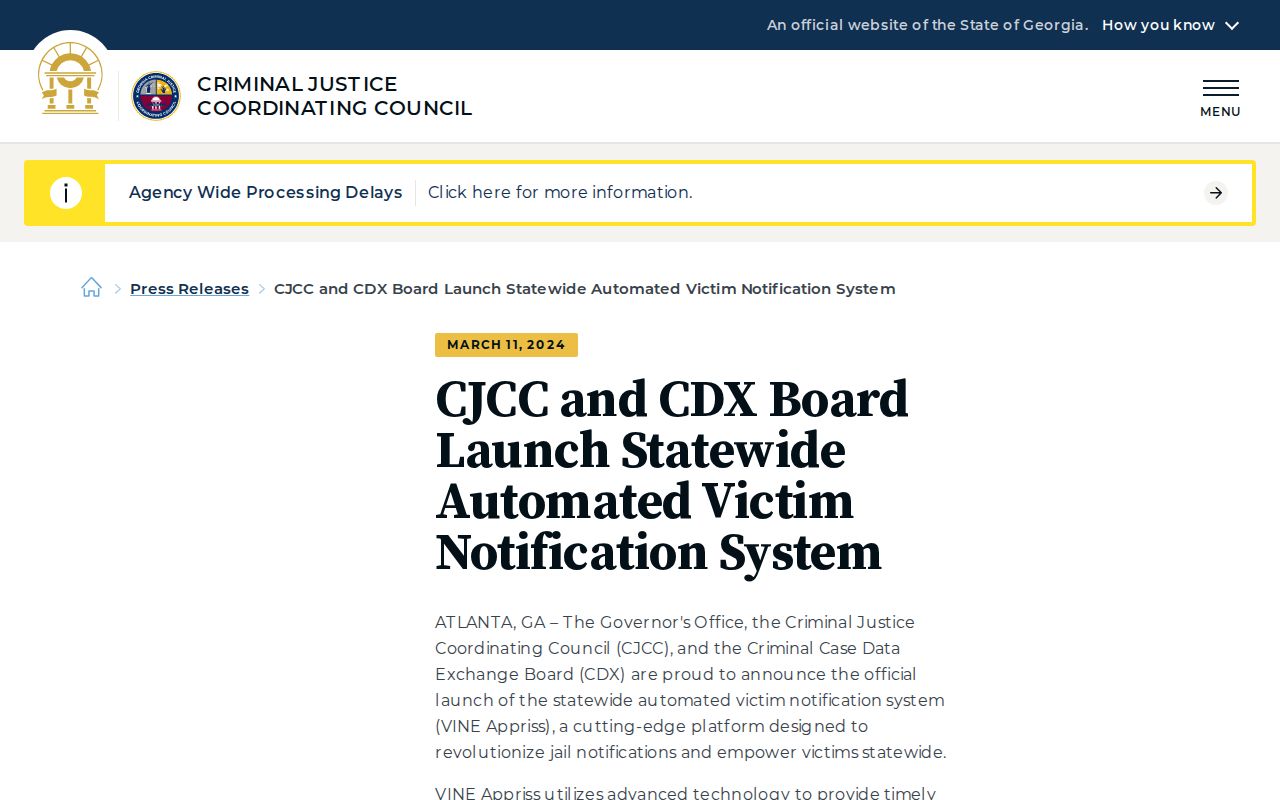
The state description supports using VINE for alerts while keeping direct agency confirmation as the final step.
Set Lamar County Release Alerts
Register only after matching the correct person. Georgia VINE may offer phone, text, email, or app notices depending on the record and current service options. A notification is tied to the selected record, so a mistaken match can produce misleading alerts.
- Open the confirmed person record and choose the available notification option.
- Select phone, text, email, or an available app method.
- Enter the requested contact information and review it for errors.
- For phone notices, create the four-digit PIN requested by VINE.
- Use that PIN to confirm receipt or manage notices when VINE calls.
- Keep the jail, GDC, or court contact available in case an alert needs urgent verification.
An alert may concern release, transfer, or another custody change. Listen to or read the full notice. “Released” from one location does not always mean free of all custody. If the notice names a transfer, follow the destination agency. If it reports release and exact proof is needed, request the originating record.
Notification registration is separate from a sheriff open-records request. VINE sends event notices. The Lamar County Sheriff's Office supplies its own jail records, while GDC supplies state-prison records. Those records answer the legal reason, release date, and custody path more fully.
Confirm Lamar County VINELink Results
VINE depends on the timing and scope of agency data. A new booking, release, or transfer may take time to appear. Older release history can fall outside the public view. A spelling difference or merged identity can also defeat a name search.
For a county-jail release, the Lamar arrest-date endpoint may show Status: RELEASED, while sheriff records can provide an inmate information sheet or other release document. For state prison, search both active and inactive records in GDC Find an Offender. For a federal sentence, use the BOP locator. ICE custody requires the ICE locator. These systems are not interchangeable.
A BOP result of “Released” or “Not in BOP Custody” means the person is not in BOP custody, but the person could still be held or supervised elsewhere. VINELink does not settle that federal question. Likewise, disappearance from a Lamar County roster does not prove community release.
Lamar County Registry Release Notices
Lamar County has no separate SAVIN layer beyond Georgia VINELink in the research. One narrow local channel does exist for registrable offenses. The sheriff-linked sex offender registry states that sheriffs update registry information within two working days and that the public registry updates daily.
The Lamar sheriff-linked registry also says a person subject to registration reports to the sheriff within 72 hours after release or placement on supervision. That timeline is about the legal registry duty. It is not a general Lamar County release feed, and it covers only people whose offenses require registration.
Keep the two services separate. VINELink may notify a registered user about a custody change for a matched record. The registry provides offense-specific post-release public information. Most people released from Lamar County custody will not appear in the registry, so a missing registry result says nothing about an ordinary release.
Lamar County Release Fallbacks
When VINE has no record, return to the custody source. Jail operations can address current Lamar County detention status. A written sheriff request can seek the inmate information sheet or release record. The court listed on the booking record may explain bond, dismissal, time served, probation, or transfer.
For a state sentence, the GDC Find an Offender search includes active and inactive scopes and release-related filters. It can show location, charges, and release-date information for a person who entered Georgia state custody. It does not cover a person who only had a Lamar County jail booking.
Use the narrowest source that owns the event. That approach helps distinguish release from the jail, transfer to another authority, release from state prison, and the end of supervision.
Lamar County Alert Timing
“Real time” does not mean each public screen changes at the exact instant a jail officer completes a release. The agency must create the event and pass it through the participating data system. Network, identity, and processing delays can follow. Keep direct jail or GDC contact available when timing is critical.
Save the matched custody ID and reporting agency before an event occurs. Those details make it easier to confirm an alert and distinguish a transfer from a final release. If the record later vanishes, the saved identifiers also help with a sheriff, corrections, or court request.
Lamar County Agency Verification
Use the event wording to choose the next call. If the matched record names Lamar County Detention Center, jail operations can confirm whether the person remains booked, left on bond, completed local time, or transferred. A sheriff records request can seek the inmate information sheet when a verbal status is not enough. The related court can explain the legal order behind the change.
If the record names GDC, use Find an Offender and compare the GDC ID, sentence, institution, and active or inactive status. GDC release dates concern state custody, not a short county booking. A parolee result adds the post-release supervision layer, while DCS Barnesville handles local field supervision for Lamar County.
Federal and immigration results require their own sources. BOP can report that a person is released or no longer in BOP custody. ICE provides its locator for eligible current or recent detention searches. Neither status belongs in Georgia VINELink as a substitute record.
Verify Lamar VINE Changes
A VINE alert should trigger a direct check, especially when the exact time or destination matters. Call Lamar County jail operations for a county booking, consult GDC for state custody, or use the named court for the disposition. The same person may move between systems, so a release from one reporting location does not prove that every hold, sentence, or supervision duty ended. Save the alert details and ask the responsible agency for the official release record when written proof is needed.