
Lamar County Mugshot Record Meaning
A mugshot is a photograph made during booking. It documents an arrest-processing event. It does not show whether the charge was dismissed, whether the person was convicted, why custody ended, or whether a later record was restricted. Release from Lamar County Detention Center also does not erase the original booking event by itself.
Georgia places specific limits on law-enforcement disclosure and posting of booking photographs. O.C.G.A. 35-1-19 governs arrest booking photographs held by law-enforcement agencies and restricts disclosure in covered commercial publication circumstances. A request should be exact, lawful, and purpose-neutral. The sheriff decides whether a responsive photo may be released under the statute and other access rules.
Find Lamar County Released Mugshots
Five researched channels can contain a photo, but none is a complete Lamar County release gallery. Start with the agency that created the relevant record. Label a state prison image as a GDC offender photo rather than a county booking photo.
| Channel | Has a photo? | How to access |
|---|---|---|
| Lamar sheriff roster | Historically yes; current root feed removed | Do not rely on the former public population page |
| Sheriff records request | Possible when lawfully releasable | Request the identified booking photograph from the records custodian |
| GDC Find an Offender | Photos display where available | Search active and inactive state offender records |
| Georgia offender registry | Registry photos may appear | Use only for an offense that requires registration |
| Local news archive | Sometimes | Search reported arrests or sheriff releases, then verify official facts |
Georgia VINELink is built for custody status and notifications, not as a Lamar booking-photo archive. The reachable arrest-date endpoint may show image placeholders in page text, but the research does not support calling it a reliable released-mugshot feed. For most local requests, the sheriff records route is the most direct official path.
Why Old Lamar Mugshot Links Fail
Local reporting in 2014 said Sheriff Brad White had created a live jail-population link with real-time information, including mugshots for people then held in the jail. That history explains why old search results and saved references may claim that Lamar County jail photographs are available online.
The current InteropWeb root page says the website was removed at the sheriff’s request. The 24-hour booking and arrest-date endpoints that remain reachable do not support a claim that there is an active release-photo gallery. No verified Lamar County, Georgia sheriff mobile app was found. Results for a Lamar County sheriff app in Texas refer to a different jurisdiction and must not be used.
Note: Historical online access does not establish that a Lamar County booking photograph remains public on the current roster.
Request Lamar County Booking Photos
The sheriff’s open-records form is the local request path. It includes requestor contact fields, an Inmate Info Sheet checkbox, an “Other” category, case number, date and time, involved names, location, and room for more details. Place “booking photograph” in the description and identify the exact booking. The agency may apply O.C.G.A. 35-1-19 and other access limits before releasing an image.
- Confirm the person’s full name and the Lamar County arrest or booking date. Add a case or warrant number if known.
- Use the Lamar County Sheriff open-records form. Select the inmate information option if related data is also needed.
- In “Other,” ask for the booking photograph tied to the identified booking, if lawfully releasable. Do not ask for an untethered name-only photo search.
- Send the request to the listed sheriff records contact. The county identifies Ginger Story at gstory@lamarcountysheriff.com, 770-358-5159 or 770-358-5377.
- Keep the response with the booking and court identifiers. A photo alone cannot establish disposition or release status.
In-person records hours are Monday through Friday, 8:00 a.m. to 4:30 p.m., at 121 Roberta Drive in Barnesville. Minimal fees may apply. Mail requests for reports require a $3 cashier’s check or money order, the case number, requester name, and a self-addressed stamped envelope. Photo fees or availability should be confirmed with the custodian rather than inferred from the report fee.
Georgia Rules for Lamar Mugshots
The official text of Georgia’s booking-photo statute is captured below. It is the key law for a public agency deciding whether and how an arrest booking photograph may be disclosed or posted.
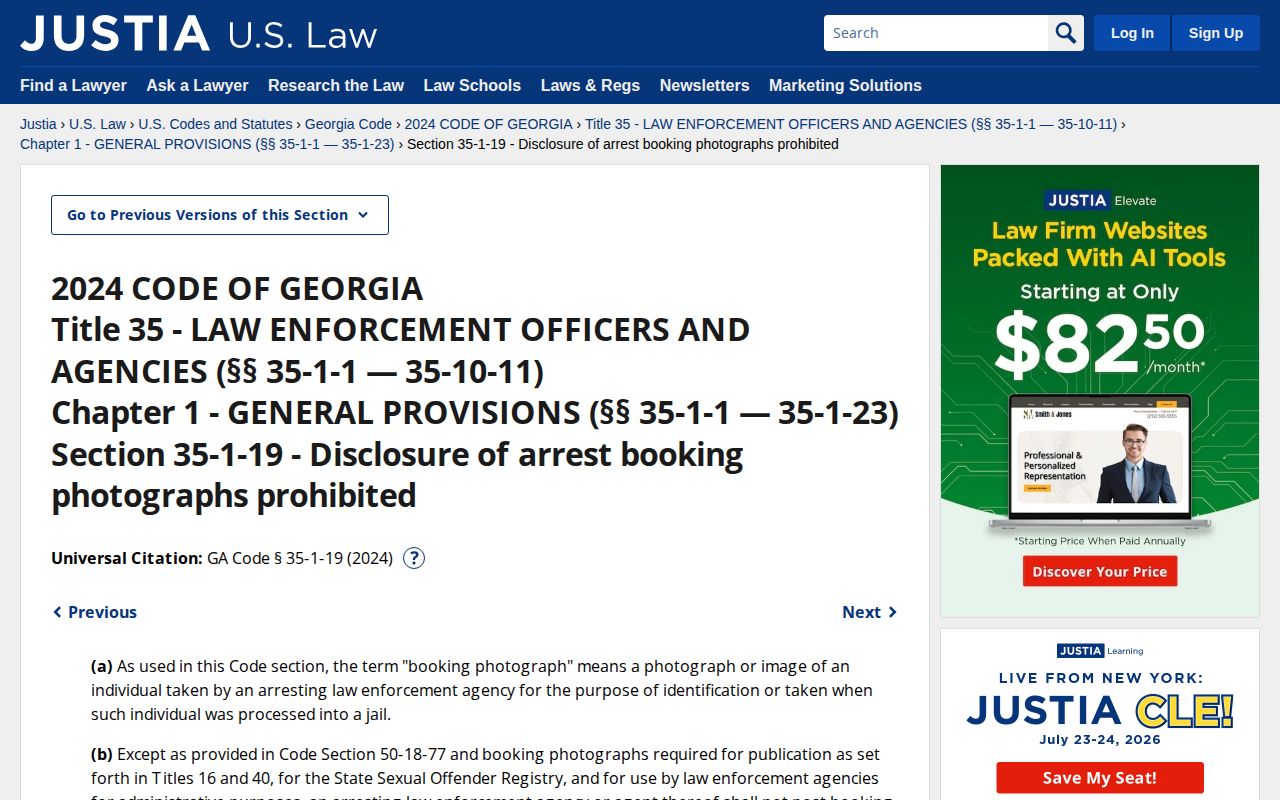
The statute view reinforces why a public-record request is not the same as an automatic right to an online photo gallery. The sheriff must apply Georgia law to the specific request.
Georgia’s Open Records Act, O.C.G.A. 50-18-71, provides the broader inspection and copying framework. The specific booking-photo rule still matters. Juvenile, sealed, restricted, and first-offender material may create further limits. When access is denied or narrowed, the response from the record custodian is more authoritative than an old cached image.
GDC Photos After Lamar Release
A person sentenced to Georgia state custody follows a different image path. GDC Find an Offender warns that photographs display automatically where available. Search by name, GDC ID, case number, and other identifiers. Include inactive offenders when checking someone already released from state prison.
A GDC photograph is a state corrections offender image. It is not the Lamar County jail booking photo, even if the state case began with a local arrest. The state result can also show facility, charges, sentence data, and release date. Verify the identity and state record before associating the image with a Lamar County case.
For someone who never entered GDC custody, the state search may return nothing. That absence does not prove that the person was never booked or released locally. Use the sheriff and court instead.
Lamar Released-Offender Registry Photos
The Georgia Bureau of Investigation registry search and the sheriff-linked Lamar registry can show photos where available. This channel applies only to offenses that require registration. It is not a general jail-release or mugshot database.
The Lamar-linked information says GBI is the central repository, registry information updates daily, and sheriffs update information within two working days. It also says required registrants report to the sheriff within 72 hours after release from prison or placement on parole, supervised release, or probation. These timing rules explain why a qualifying person may appear after release, but they do not apply to ordinary bookings.
Never treat absence from the registry as proof of no arrest or no release. It usually means the registry is not the right channel.
Lamar Mugshots in Local News
Barnesville.com’s Crime and Arrests archive is the strongest continuing local news channel found for sheriff releases, police reports, arrests, and law-enforcement coverage. A reported case may include an image or enough detail to locate the official file. Coverage is selective. It is not a complete list of Lamar County bookings or releases.
News reports should be used as leads. Match the name, date, charge, and agency to the sheriff or court record. A story may remain online after the case changes, and an image caption may not show the later disposition. The article date is not a release date unless the report expressly and accurately says so.
No commercial mugshot publisher or paid removal service is linked or recommended. Such pages can carry stale copies, unclear sources, and incomplete case context. Official agency and court records are the proper verification channels.
Lamar Record Restriction and Photos
Record restriction can change what criminal-history information is publicly available. The sheriff administrative page explains that O.C.G.A. 35-3-37 governs eligible restriction. For arrests after July 1, 2013, the person contacts the prosecutor rather than applying through the arresting agency. The Towaliga Judicial Circuit District Attorney says it reviews record-restriction requests sent from law-enforcement agencies.
Restriction, sealing, and expungement are not interchangeable terms. Restriction limits access to qualifying Georgia criminal-history information. Sealing is a court-controlled limit on specified records. “Expungement” is still commonly used, but Georgia agencies often use “record restriction.” None should be described as a universal erasure of every copy held by every publisher.
For the original Lamar County photo, ask the sheriff what effect a completed restriction or sealing order has on access and posting. For a court image or state corrections photo, contact the office that controls that separate record. Supply the order or case information needed to identify the image.
Georgia Mugshot Removal Protections
Georgia law separately addresses certain commercial websites that publish mugshots and charge for removal. The Georgia Attorney General Consumer Protection Division explains that O.C.G.A. 10-1-393.5 can require a qualifying site to remove an image without charge within 30 days after a written request when statutory circumstances apply.
The state consumer information is captured below.
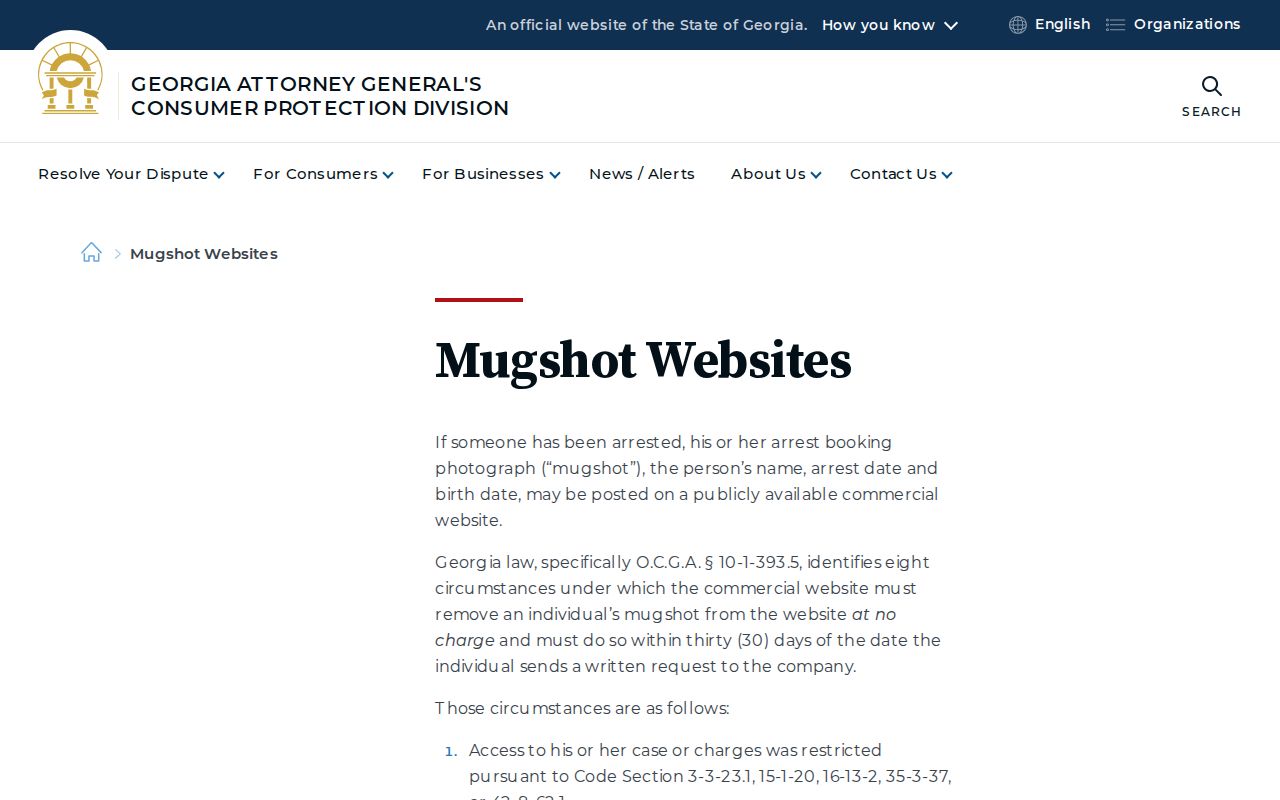
The state page supplies the official overview. It does not promise that every image, publisher, or circumstance qualifies, so follow the stated criteria and preserve a copy of the written request.
Verify Lamar Released Mugshot Identity
Before linking a photo to a released person, compare the full name, booking date, arresting agency, case or warrant number, charge, and court. Similar names are not enough. Then use the court disposition to learn what happened after arrest and the sheriff release record to learn when local custody ended.
Keep the source label intact. “Lamar County booking photograph,” “GDC offender photograph,” and “registry photograph” describe different records. If the public source no longer provides the image, do not infer that an old copy is current or complete. Ask the record owner.
Lamar court routing depends on the charge entry. Superior Court criminal records, Magistrate Court warrant matters, and Probate Court local traffic or misdemeanor cases do not share one public file. Use the court named in the arrest record and request the disposition that follows the pictured booking. That final record can add the context a photograph lacks.