
Lamar County Projected Versus Actual Release
A projected date is a calculation or planned event. An actual release date records what happened. That distinction matters in Lamar County because a jail detainee may leave on bond or by court order without ever having a sentence-end date. A county-sentenced inmate may have an expected end based on the sentence and earned time. A GDC prisoner may have a maximum release date, a tentative parole month, or both.
Georgia rule 125-2-4 defines a Maximum Release Date as the date a state prisoner would leave GDC after serving the entire sentence, apart from parole decisions. A Tentative Parole Month, or TPM, is the year and month planned for parole placement by the Board. A TPM is not a final grant. Life and death sentences do not have a maximum release date under that definition.
- Maximum Release Date
- The GDC full-service date apart from parole.
- Tentative Parole Month
- A planned month for final parole review, not a promised release.
- Actual release
- The date custody truly ended or shifted to another authority.
- Detainer
- A request by another authority to hold or take custody of a person.
Find Lamar County Projected Release Dates
Begin with the present custody authority. The Lamar County Detention Center, GDC, and federal systems keep separate records. A transfer out of the county jail is not the same as release to the community. The court record identifies whether a sentence is county time, city time, state time, probation, or another disposition.
- Check the Lamar County booking or court record to identify the case, sentence, and custody level.
- For a pretrial detainee, review bond and court orders. Do not expect a fixed projected release date.
- For county or city time, ask jail records and the sentencing court for the sentence, jail credit, and expected completion.
- For state time, search GDC Find an Offender using active and inactive scopes as needed.
- Use the Board TPM lookup for parole consideration, while treating the month as tentative.
- Confirm the result with the jail, GDC records, counselor, clerk of court, or Parole Board that owns the date.
GDC's public search can show location, charges, and release-date information for state offenders. Its fields include sentence status, conviction county, active or inactive scope, GDC ID, and case number. A person who only bonded out of Lamar County Jail may have no GDC entry. Use the Lamar County release-record path for county-only cases.
For written state verification, the GDC search disclaimer points to Inmate Records and Information, P.O. Box 1529, Forsyth, GA 31029. That written route is important when the displayed date affects a court filing, travel plan, or family coordination.
Lamar County Earned-Time Release Rules
County and state sentences use different frameworks. For a Lamar County inmate sentenced to county confinement, O.C.G.A. 42-4-7 states that release occurs at sentence expiration less earned-time allowances. The sheriff says people sentenced to county or city time remain until service is complete under law, while people sentenced to state time may transfer to a GDC facility.
For eligible state offenders, O.C.G.A. 42-5-101 authorizes work incentive credits. The GDC Performance Incentive Credit program allows eligible offenders to earn up to twelve PIC points. Those credits may reduce a TPM or maximum release date by one to twelve months based on approved work, programs, and conduct.
Credits are not automatic for every sentence. Serious violent felony rules in O.C.G.A. 17-10-6.1 require many listed terms to be served in custody without parole or early-release reductions, subject to narrow statutory exceptions. The listed crimes include murder, armed robbery, kidnapping, rape, aggravated child molestation, aggravated sodomy, and aggravated sexual battery.
General parole eligibility under O.C.G.A. 42-9-45 is also subject to offense, sentence, recidivist, life-sentence, and other exceptions. Eligibility only means the Board may consider parole. It does not set an actual Lamar County release date.
Why Lamar County Release Dates Change
A correct date today can move after new information reaches the record. Sentence credit may be corrected. A court may amend an order. GDC conduct and program decisions can affect credits or parole timing. Another authority may lodge a detainer that changes the release destination without extending the original sentence in the same way.
| Factor | Possible effect | Source to confirm |
|---|---|---|
| Jail credit correction | Changes the effective sentence start or end | Clerk of court and GDC sentence computation |
| Concurrent or consecutive terms | Changes how multiple sentences combine | Sentencing order and corrections record |
| Disciplinary report | May reduce credits or postpone a TPM | GDC counselor and Parole Board |
| Program completion | May support PIC credit or a parole condition | GDC and Board records |
| Parole action | May set, postpone, cancel, deny, or withdraw release | State Board of Pardons and Paroles |
| Detainer or hold | May cause transfer to another authority | Holding agency and requesting authority |
| Court order | May correct or alter the sentence | Clerk of the sentencing court |
GDC advises an inmate with a sentence-computation concern to speak with the counselor first. If credit for time served is wrong, the clerk in the county of conviction may need to correct or clarify the court record. In a Lamar County conviction, that means following the case to the correct local court rather than asking the jail to change a state sentence.
Parole guidelines are not a calculator. Under O.C.G.A. 42-9-40, the Board considers offense severity, prior history, conduct, and predictive factors. The Board may accept or reject a guideline recommendation.
Confirm Lamar County Actual Release
Use the source that controls the custody. For the Lamar County jail, call jail operations or request the inmate information sheet and release record. A court disposition can explain bond, dismissal, time served, probation, or state transfer. For a GDC prisoner, check the active or inactive offender result and obtain written verification when exact proof matters.
A VINELink release check can add a pending custody-change alert where the person appears in Georgia VINE. The notice is useful, but it may lag and does not replace a discharge document. For parole, confirm through the Board and DCS. For federal custody, use BOP rather than GDC or VINELink.
Released and still in custody require opposite searches. The live jail or active GDC locator is for a person still held. A released person is more likely in a status-updated jail record, inactive GDC record, court disposition, parolee database, or formal release document.
Lamar County TPM Is Tentative
The State Board TPM page makes the key limitation clear. A tentative parole month marks the month for final review and, if appropriate, the setting of a parole release date. It can depend on good conduct or completion of treatment and other programs. Misconduct can lead to postponement or cancellation.
The Board may establish a TPM, deny parole, reconsider the case, postpone action, cancel the month, or withdraw a grant before release takes effect. A parole to a detainer may result in conditional transfer to another authority rather than a return to Lamar County. Public monthly Board meetings do not decide individual offender cases.
The official TPM page shows the state tool used for this projected date.
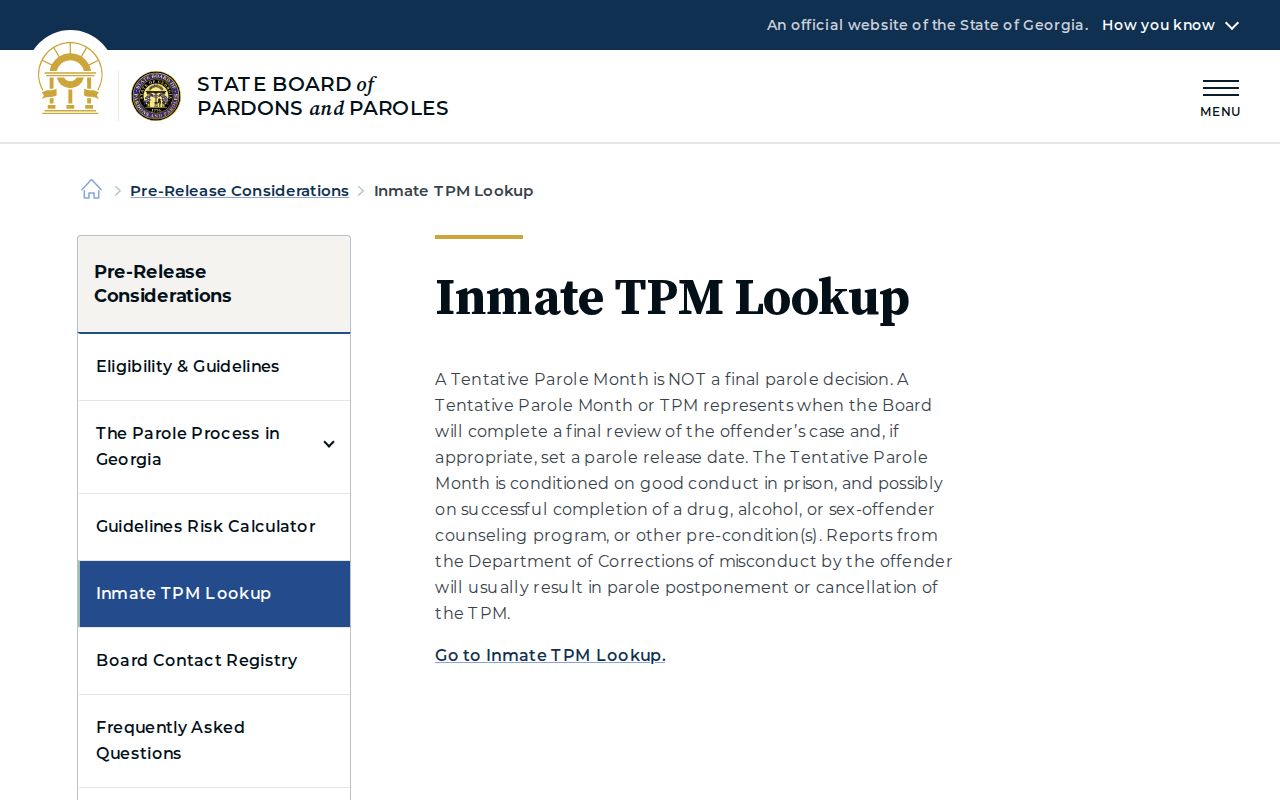
The lookup should be read as a parole-planning record, not an exact promise of release.
Lamar County Jail Versus GDC Dates
The sheriff's jail page says the Lamar County Detention Center holds people after booking, permits bond where allowed, and keeps sentenced people for county or city time or until transfer to a state facility. Those paths create different date records. Bond release turns on the bond and court process. County time follows the local sentence and earned-time framework. State time shifts the calculation to GDC.
A transfer date is not a state-prison release date. When a person leaves the Lamar jail for GDC, the county record should show the custody change, while the GDC record later carries state sentence and release data. If the person instead leaves on bond, GDC may never have a record at all.
Check the “court” field on the Lamar booking result and obtain the sentence or disposition. That document is the bridge between the jail event and the correct release-date system. It also prevents a pretrial bond question from being treated as if it were a prison good-time calculation.
Lamar County Parole Eligibility
Georgia's general rules can mark when a person becomes eligible for parole consideration, but they do not promise a release date. The statute generally addresses misdemeanor eligibility after six months or one-third of the sentence, whichever is greater, and felony eligibility after nine months or one-third, whichever is greater, unless another law controls. Aggregate terms, recidivist rules, serious offenses, and life sentences can change that framework.
The Board's guidelines may recommend months to serve or a share of the sentence. Board members can accept or reject that recommendation after reviewing offense severity, prior history, conduct, and other case factors. Thus, an eligibility date, a guideline recommendation, a TPM, and an actual release are four separate points.
Lamar County Date Record Checklist
Before relying on any date, record the person's full name, booking or corrections ID, court case number, custody agency, sentence type, and the label attached to the date. “Sentence end,” “maximum release,” “parole eligibility,” and “tentative parole month” do not mean the same thing. A screenshot without the field label can create needless confusion.
Then ask whether another case or authority is involved. A detainer, separate county warrant, federal matter, or consecutive term can change the destination at the end of Lamar County or GDC custody. The original sentence may end on schedule even though the person does not enter the community.
Keep the final confirmation from the agency that carried out the event. That may be a Lamar County inmate information sheet, a court order, an inactive GDC record, a parole certificate, or another authority's intake record. The source and field name are as important as the date itself.
Confirm Lamar Date Changes
When a displayed date shifts, compare the latest GDC record with the sentencing court file before assuming an error. GDC advises that an incarcerated person first raise sentence-computation concerns with a counselor; a correction may also require records from the clerk in the county of conviction. Family members can ask GDC Inmate Records and Information to verify the published field, while the Parole Board remains the source for TPM decisions.